
Enterprise applications increasingly depend on APIs, containers, databases, cloud services, and interconnected software components. A customer-facing transaction may cross several systems before it completes. Each component can appear healthy while the overall experience deteriorates. For IT leaders, this creates a question that infrastructure dashboards alone cannot reliably answer: why is a critical business journey failing?
Traditional monitoring remains essential. However, modern enterprise operations increasingly require observability: the ability to investigate how distributed systems behave using sufficiently rich operational evidence. AI-assisted analysis can help teams interpret that evidence, but it does not replace sound engineering, reliable telemetry, or human judgment.

The Limits of Traditional Monitoring
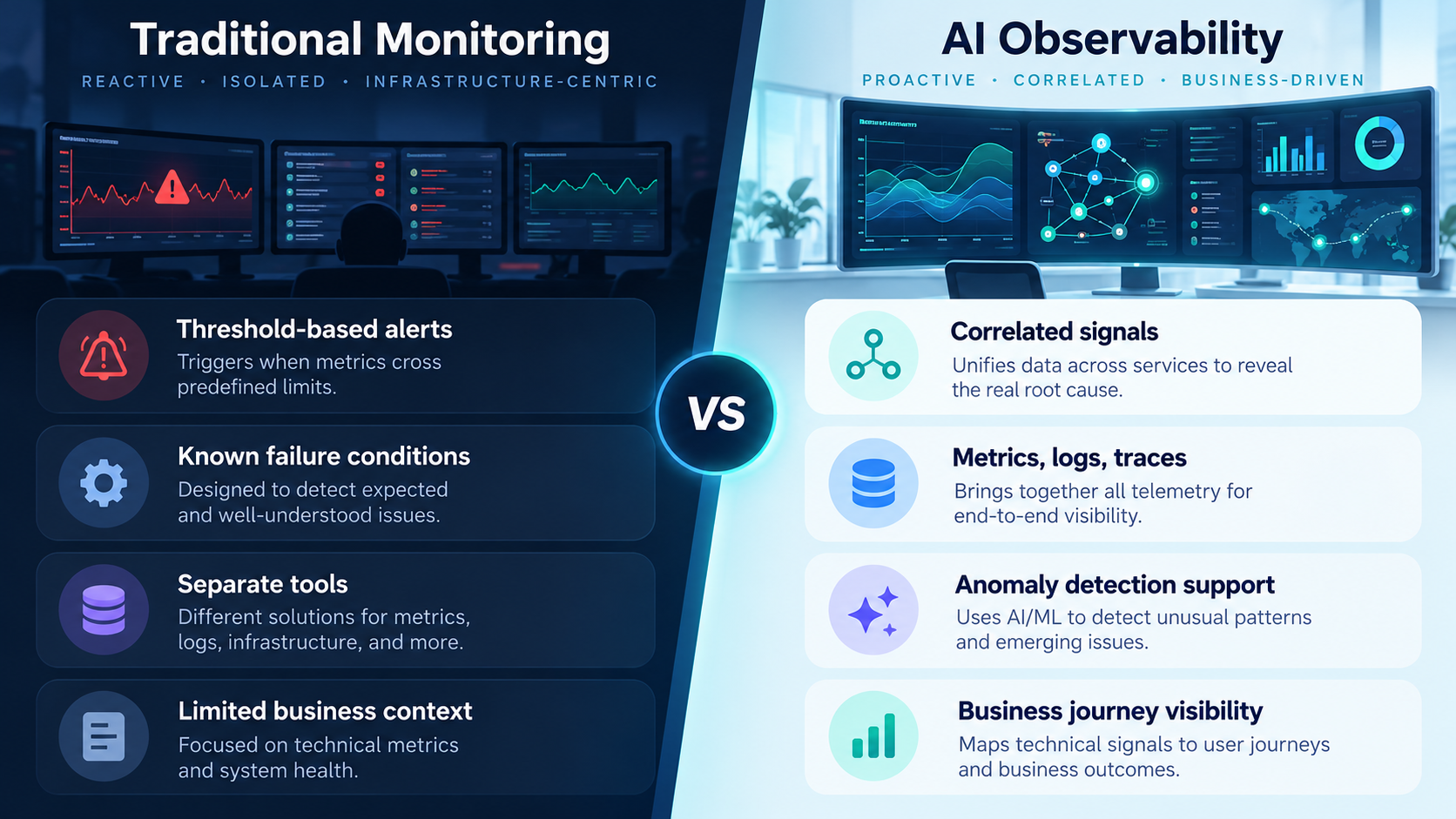
Traditional monitoring commonly checks predefined thresholds, device availability, resource utilization, and known failure conditions. Google’s Site Reliability Engineering guidance recommends tracking four golden signals for user-facing services: latency, traffic, errors, and saturation. These measurements remain highly relevant; the challenge is interpreting them across complex application dependencies.
Consider a mobile banking login that suddenly becomes slow. The web server may report normal CPU utilization, yet a downstream identity service, database query, or external API could be responsible. Separate infrastructure alarms may not explain the complete transaction path. Monitoring detects the symptom; deeper observability helps engineers investigate its possible causes.
Observability Connects Signals and Context
Modern observability combines metrics that quantify performance, logs that record events, and traces that follow requests between services. According to the OpenTelemetry project, telemetry instrumentation enables teams to ask new diagnostic questions without predicting every failure in advance.
Distributed traces can reveal where a request spent its time. Correlated logs can supply error details, while service metrics indicate whether a problem is widespread or isolated. OpenTelemetry provides a vendor-neutral framework for generating, collecting, and exporting these signals. It is an interoperability foundation, not a guarantee that every incident will be diagnosed automatically.
What AI Adds—and What It Does Not
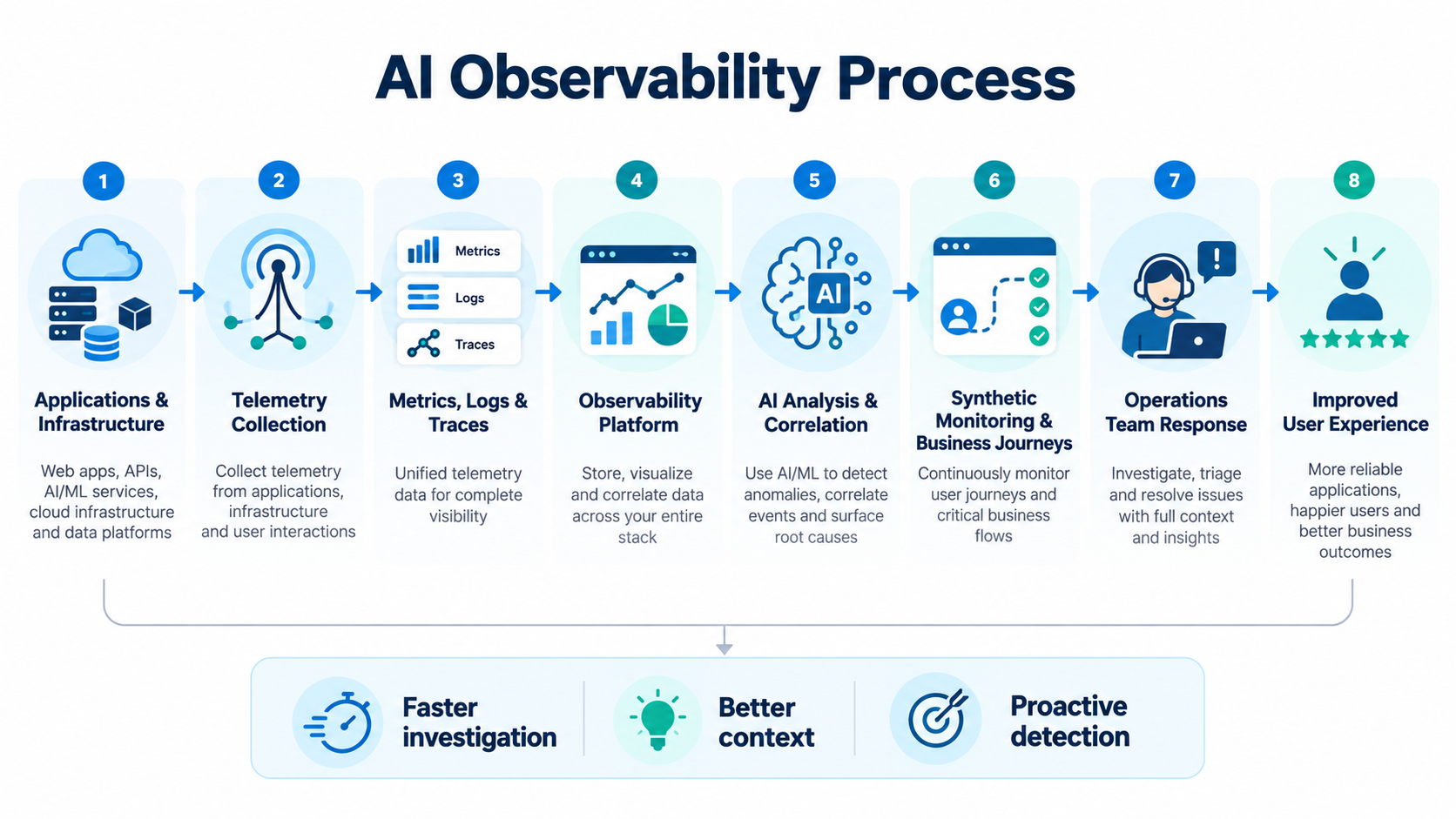
AI-assisted observability applies statistical and machine-learning techniques to operational data. Potential uses include identifying unusual patterns, grouping related alerts, summarizing incident timelines, and highlighting dependencies worth investigating. Such capabilities are particularly useful when thousands of events compete for an operator’s attention.
Nevertheless, an anomaly is not necessarily a root cause, and an automatically generated incident explanation can be wrong. Data quality, missing instrumentation, model drift, and poorly defined baselines can all reduce accuracy. Production remediation—especially changes affecting financial transactions or regulated services—should use explicit safeguards, audit trails, and appropriate human approval.
A May 2026 CNCF-hosted industry article describing a survey of 407 practitioners reported interest in AI anomaly detection alongside a substantial preference for human oversight before fully autonomous remediation. That survey is useful directional evidence, not proof that AI observability delivers a fixed return on investment.
Why Business Journeys Matter
For executives, application availability is not the same as a successful customer experience. An application may respond to health checks while users cannot complete payment, registration, or account access. This is where synthetic monitoring complements observability: controlled test journeys repeatedly exercise important workflows from a user perspective.
For example, synthetic tests may detect a failed login before a large number of customers report it. Engineers can then use traces, logs, and metrics to investigate the responsible components. These approaches serve different purposes and should be designed together rather than treated as competing technologies.
A Practical Enterprise Adoption Roadmap
First, identify critical journeys. Prioritize revenue-related and operationally essential transactions, then define measurable service-level objectives covering availability and user-perceived response time.
Second, establish trustworthy telemetry. Instrument key dependencies, standardize service identifiers, and evaluate OpenTelemetry where appropriate. Control sensitive data exposure and the cost of collecting high-cardinality telemetry.
Third, correlate technical and business impact. Connect synthetic transaction outcomes with application traces, logs, and performance metrics. Test incident scenarios to verify whether the available evidence supports diagnosis.
Fourth, introduce AI selectively. Start with alert deduplication or incident summarization, evaluate false positives and missed signals, and retain human decision-making for high-impact changes.
Implications for Indonesian Enterprises and RDI
Financial institutions, telecommunications operators, and digital service providers in Indonesia depend on reliable application journeys. Their observability strategies should reflect operational risk, data governance, architecture, and the maturity of existing teams—not merely product feature lists.
For PT Real Data Indonesia (RDI), the topic connects with its focus on application performance and synthetic monitoring, including the RASBOT portfolio. A sensible engagement begins with defining critical customer journeys and evaluating monitoring coverage before discussing integrations or AI-assisted workflows. Specific performance gains should be demonstrated through customer-approved testing, not assumed.
Next step: Organizations can contact RDI to discuss synthetic monitoring, observability assessment, and enterprise application reliability: www.realdataid.com | info@realdataid.com.
References
- Google SRE — Monitoring Distributed Systems
- OpenTelemetry — Observability Primer
- OpenTelemetry — Official Documentation
- CNCF Blog — Industry Survey Discussion, May 6, 2026