
Enterprise AI is moving beyond isolated chat interfaces toward applications that coordinate multiple services, agents, and business transactions. While language models attract much of the attention, the reliability of the underlying data platform remains essential. For many organizations, the architectural question is not simply how to store more information, but how to maintain correct, available, and scalable transactional data as workloads grow.
Why AI Applications Still Need Transactional Databases
AI agents may retrieve information, initiate workflows, and interact with business systems. When these activities create orders, change customer records, or update operational states, enterprises need transaction guarantees, access controls, and auditable data changes. A vector store or model context window does not replace the role of a transactional system of record.
What Distributed SQL Adds
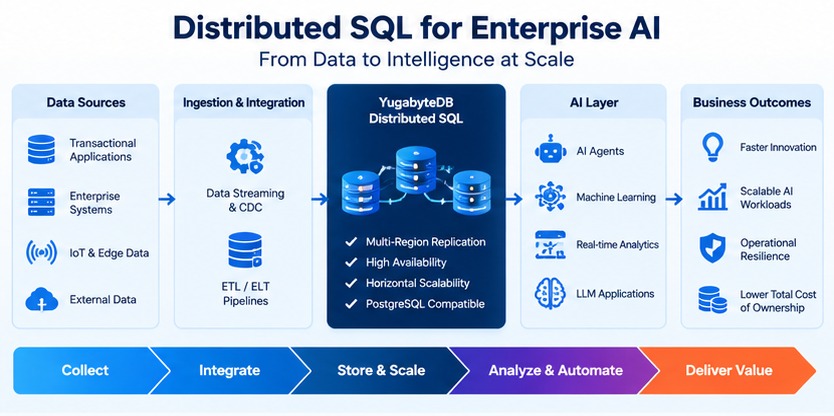
Distributed SQL combines relational query capabilities with data distribution across nodes. Depending on the platform and configuration, this can support horizontal scaling, replication, and resilience against individual component failures. However, distribution introduces its own design trade-offs, including network latency, transaction coordination, operational complexity, and cost.
Five Architecture Questions to Ask
- Workload profile: What are the expected read/write rates, concurrency levels, and transaction patterns?
- Data correctness: Which operations require strong consistency and ACID transactions?
- Availability: What are the recovery time and recovery point objectives?
- Compatibility: Which PostgreSQL features, drivers, extensions, and application behaviors must be preserved?
- Economics: Does distributed deployment improve the overall cost and risk profile compared with a simpler architecture?
YugabyteDB as an Evaluation Option
YugabyteDB provides a distributed SQL architecture with PostgreSQL compatibility through YSQL and support for ACID transactions. Its horizontal scaling and replication features make it relevant for evaluating certain mission-critical enterprise workloads. PostgreSQL compatibility is not identical to complete feature equivalence: organizations must verify their actual applications, SQL features, extensions, and operational tools.
Yugabyte has also introduced products aimed at agentic workloads, including YugabyteDB AMP. These developments are worth examining, but the existence of an AI-oriented offering does not mean every AI application needs distributed SQL.
Connection Management Matters Too
On 14 October 2026, Yugabyte announced general availability of its native YSQL Connection Manager. This is particularly relevant for microservices and autoscaling environments where application instances may create large numbers of connections. Vendor performance figures should be independently validated against the organization’s own workloads and service-level objectives.
Practical Proof-of-Concept Framework
RDI recommends starting with a representative application workload and defining measurable acceptance criteria before choosing a database architecture. A proof of concept should cover functional compatibility, concurrency, p95/p99 latency, failover behavior, security configuration, backup and restore, observability, and operational cost. Testing should compare realistic alternatives rather than relying only on headline throughput figures.
Where This Matters in Indonesia
Banking, financial services, telecommunications, and digital commerce frequently operate transaction-sensitive applications. Their requirements differ, and any migration decision must account for compliance, existing architecture, team capability, and business continuity. Distributed SQL should be considered when its benefits address a demonstrated requirement—not simply because the application uses AI.
How RDI Can Help
PT Real Data Indonesia supports enterprise technology assessment, systems integration, and technical evaluation. For organizations exploring distributed SQL or YugabyteDB, RDI can discuss architecture requirements and a structured proof of concept based on the customer’s actual workloads.
Contact: info@realdataid.com | www.realdataid.com
References
- YugabyteDB official documentation
- YugabyteDB PostgreSQL compatibility documentation
- Yugabyte: YSQL Connection Manager Is Now GA, 14 October 2026